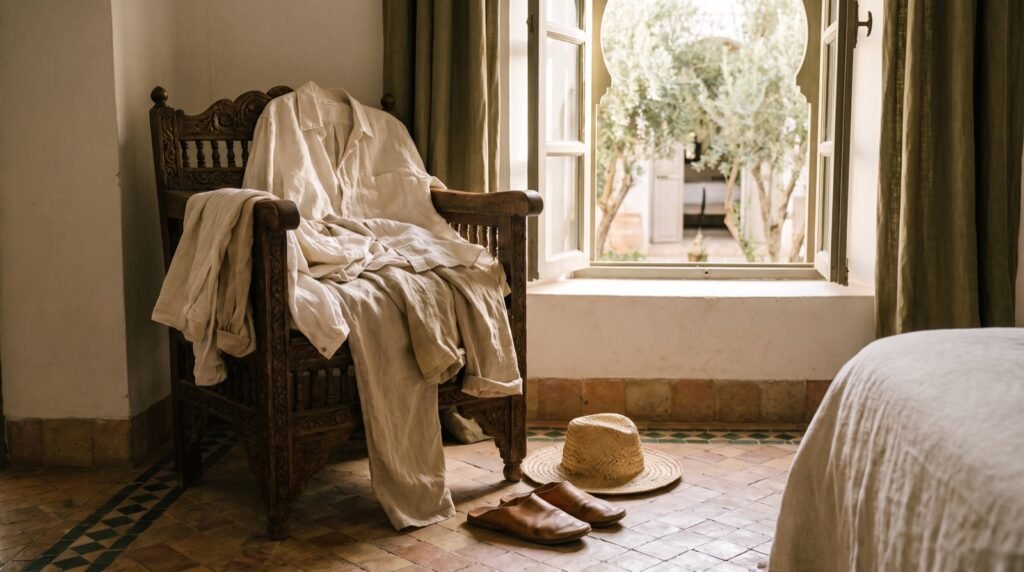
What should I wear in Marrakech?
Loose clothes that cover your shoulders and knees, in cotton or linen, with closed shoes you can walk miles in. That one combination handles the heat, the dust and the courtesy expected in the old city. Add a light scarf and you have sun cover, something to pull over your face in a dusty alley, and an extra layer for the evening, all in one item.
Do I need to cover my shoulders and knees?
No law requires it, and you will see visitors in vests and shorts. We still suggest covering up in the Medina, which is a residential quarter where families live and work, not a resort. It is practical as well as polite, and some women find it draws slightly less comment — though touts read you as a visitor whatever you wear, so don’t expect covering up to stop the attention. In Gueliz and Hivernage dress is relaxed — jeans, dresses, short sleeves, no scarf — but Moroccan women there still rarely wear shorts or vest tops, so a visitor in them is noticed even if nobody minds. Around pools, anything goes. During Ramadan, err towards more covered in the street.
What fabrics cope with the heat?
Cotton, linen and anything loose and natural. Synthetics sit against the skin and hold sweat; by mid-afternoon in summer you will regret them. Long and loose is genuinely cooler than short and tight once the sun is high — that is why local dress looks the way it does. Choose light colours, but skip white trousers. The dust here is fine and pinkish and it settles on everything.
What shoes work in the souks?
Closed, flat, and already broken in. The alleys are uneven, dusty, occasionally wet near the food stalls, and mopeds pass close enough to clip an exposed toe. Backless slides slip on worn tile. Trainers or closed flats are the sensible daytime answer; keep the good sandals for dinner. You will walk considerably further than you plan to.
Where is swimwear fine, and where is it not?
At pools it is completely normal — hotel and riad pools, and the day-pool clubs out towards the Palmeraie and the Route du Barrage. Bikinis are unremarkable in those spaces. Take a kaftan, sarong or shirt to cross the courtyard in, because a riad courtyard is shared space and staff are working in it. What does not work is walking out into the street or through the Medina in swimwear or a bikini top.
What do you wear to a hammam?
Less than you might think, but not nothing. In a traditional neighbourhood hammam, women wear knickers and nothing above the waist; men wear shorts or swimming trunks. In a spa hammam, disposable pants are usually provided, or wear a swimming costume you are not attached to — black soap and scrub oils stain. Bring flip-flops, a hair tie and dry underwear for afterwards. Wear something loose to leave in: you come out warm and slow, and a tight waistband ruins it.
Marrakech gets cold — what to pack for nights and the mountains
A light layer is worth the space in any season — the temperature drops sharply after sunset all year. From November through March add a proper jacket: a day that reached 18-20°C falls to about 6-10°C after dark, and January nights can touch freezing. Riads are built of thick walls and tile to stay cool, so they hold that cold indoors; heating is often a single portable heater. Rooftop dinners are colder than people expect.
For a day in the Atlas, dress warmer again and wear proper shoes. The valleys sit well above the plain and run several degrees colder before you add wind and shade, and the high peaks keep snow well into spring. Take a fleece, a windproof layer, trousers rather than shorts, and shoes with grip — even a gentle valley walk involves loose stone and stepping across water. Ourika is about an hour each way, Imlil and Oukaïmeden closer to ninety minutes, and anything over the Tizi n’Tichka pass is three to four hours. You leave in the cold and come back in it.
Common questions
Can I wear shorts in Marrakech?
Yes, shorts are legal and common among visitors in Marrakech, but knee-length or longer is more comfortable and draws less attention in the Medina, which is a residential quarter. Around hotel pools and in the new town, shorts are unremarkable. For a day in the Atlas Mountains, wear trousers instead u2014 it is colder and the ground is rough.
Do women have to cover their hair in Marrakech?
No. Visitors are not expected to cover their hair anywhere in Marrakech, including the Medina, and many Moroccan women in the city do not either. A light scarf is still worth carrying for sun, dust and cold evenings rather than for modesty.
What do you actually wear in a hammam?
In a traditional neighbourhood hammam, women wear knickers and nothing above the waist, and men wear shorts or swimming trunks. In a spa hammam, disposable pants are usually provided, or you can wear a swimming costume you do not mind staining, as black soap and scrub oils mark fabric. Bring flip-flops, a hair tie and dry underwear for afterwards.
Does it get cold in Marrakech at night?
Yes. The temperature drops sharply after sunset all year, and from about November to March the evenings are genuinely cold u2014 overnight lows around 6-10u00b0C. Riads are built with thick walls and tile to stay cool in summer, so they hold that cold indoors and are often heated by a single portable heater. Pack a light layer whatever the month, and a proper jacket from November to March.
What shoes should I pack for Marrakech?
Closed, flat shoes that are already broken in u2014 trainers or closed flats work best. The souk alleys are uneven, dusty and sometimes wet, and mopeds pass close by, so open toes are exposed. Keep smarter sandals for dinner, and bring shoes with grip if you are heading into the mountains.
Planning a stay in Marrakech?
Tell us your dates and what matters to you, and we come back with what fits.