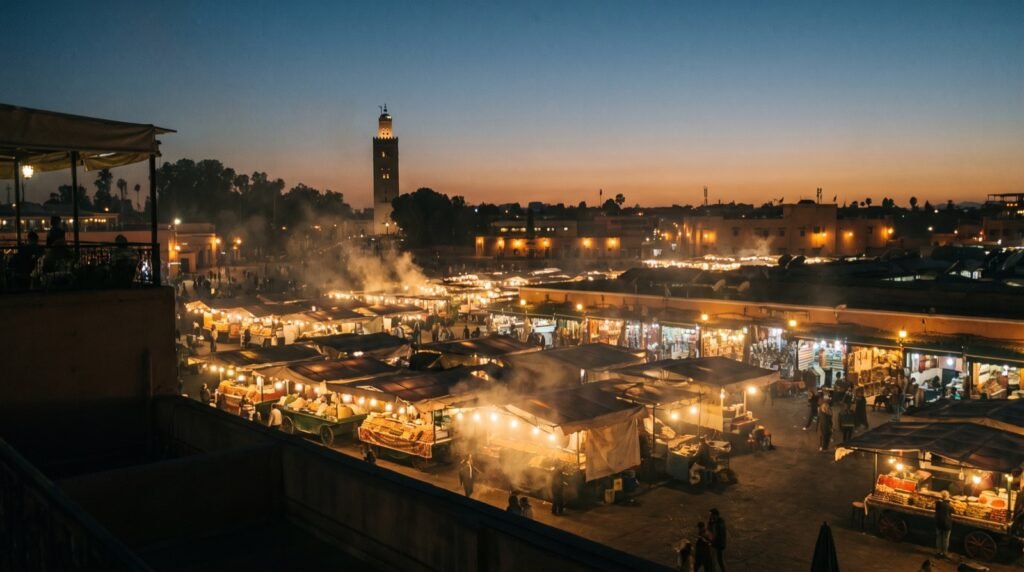
What is Jemaa el-Fna?
Jemaa el-Fna is the open square at the mouth of the Marrakech medina, and it resets its character several times a day. It is not a monument. There is nothing to queue for and nothing to see except what people are doing on it. The Koutoubia minaret stands a short walk west and is your reference point when you lose your bearings. Taxis stop at the edge and you walk in, because the square is closed to through traffic. It is not fully pedestrianised, though: vans work it in the morning and mopeds cross the open ground at all hours. Name the side you want, or you will be dropped at the edge furthest from where you are staying. Agree the fare first; meters go unused after dark.
What is the square like in the morning?
Mornings are quiet, and until about ten the square belongs to deliveries, cleaners and the orange juice carts. The carts are pushed into position early and stay all day; order one, watch it pressed, drink it standing. A snake charmer or two and the first henna women set up as the early groups arrive, but the pressure is low and the light is good. If you want photographs of the space itself rather than of performers, come now.
Why does the square empty in the afternoon?
The middle of the day is hot and there is almost no shade, so most people clear off. The open ground radiates heat and in summer it is genuinely unpleasant. That is the summer pattern, though: in winter the afternoons are mild and the square stays busy straight through. Spend a hot afternoon in the souks off the northern edge, or on a terrace. The square rebuilds late: drums start, circles form, the crowd thickens as the light drops. Ramadan inverts everything. Nothing is served until the cannon at sunset, and then the square fills within minutes and runs past two in the morning.
What happens on Jemaa el-Fna in the evening?
At dusk the food stalls are wheeled in and the square turns into a smoky open-air kitchen. Frames go up around five, the rows are cooking by seven, eight to ten is the crush, and the last stalls come down around one. Each stall is numbered and worked by someone with a laminated menu and quick English. You will be called at constantly. Grilled meat, merguez, harira, snails in broth, sheep’s head if you are curious.
The menus look identical but the cooking is not. Pick a stall with a full bench and fast turnover, and watch your food go on the grill; soups and slow-cooked dishes sit in pots, so be choosier there. Do not use whether Moroccans are eating as your test, because the numbered rows are mostly tourist trade and Marrakchis eat at the snail carts and the sheep’s-head stalls round the edge. Then watch the bill, which is where the evening actually goes wrong. Bread, olives, harissa and salad arrive unordered and get charged. Order by the board, send back what you did not ask for, and check the addition. Cash only, small notes, and nobody has change.
Circles form for gnaoua musicians with their metal qraqeb, for Chleuh acrobats from the Souss, for boxers, drummers and dancers in drag with hendir drums. Off to the side sit fortune tellers with cards and candles, tooth-pullers with a tray of extracted molars, and the bottle-fishing game, where Marrakchi families stand. What you hear performed is Moroccan Arabic or, as often, Tachelhit, so you will be reading the crowd rather than the tale. The old storytellers, the hlaykia, are down to a handful of men and not out every night; a circle standing still and listening rather than watching is one. Stand at the edge, watch, and give something if you stay.
Do you have to pay for photographs?
Yes. Everyone performing on the square earns from photographs: snake handlers, monkey handlers, the water sellers in red, henna women, musicians. Agree what you are paying before the camera comes out, never after; the argument afterwards is unpleasant and easily avoided. A long lens from across the square still counts, and is still noticed.
A monkey handler may put a Barbary macaque on your shoulder without asking. Say no clearly and keep moving rather than stopping to discuss it. Plenty of visitors find the animals’ condition upsetting, and if that is you, the clean position is not to engage at all. Henna works the same way: a hand gets taken and the design started before anything is agreed. Pull it back, and know what you are refusing. Much of the paste on the square is black henna, cut with the dye PPD, which can cause chemical burns and a lifelong allergy to hair dye, and the reaction usually appears days later, once you are home. Real henna is a muddy green-brown paste that stains orange and darkens over a day or two. It is never black on the skin. Refuse anything jet black in the cone, or anything that turns black on you within minutes, because the scar it can leave is the shape of the design.
Where are the best views over the square?
From the café terraces on the south and east sides, which have upper floors and roofs looking straight down onto the stalls. The south side looks along the length of the stall rows and is the shot people mean; the west side is only road, the calèche rank and the Koutoubia gardens. You will be expected to order something, and that is a fair trade for the seat: tea, coffee and juice, not alcohol. Go up well before sunset if you want a place at the rail, because nobody gives up a table. The view down onto the smoke and the lights is the photograph people come for.
Is Jemaa el-Fna safe at night?
Usually, with ordinary crowd sense: the problem visitors report is pickpocketing rather than confrontation, though that is the common pattern and not a guarantee. Phones live in a front pocket or in your hand, never the back pocket, and filming with both arms up is the moment you are least aware of your bag. Wear a cross-body strap and keep the bag in front of you. Watch for scooters everywhere, not just the roads at the edge. They cut straight across the square all evening, between the stall rows and through the crowd, fast, weaving and usually without lights. Listen behind you, and do not step backwards to frame a photograph. If a stranger says the souks are closed today, or that a Berber market or a festival is on for one day only, that is an opener. So is unsolicited help with directions, which ends at a shop. Keep walking.
Common questions
Is Jemaa el-Fna worth it, or is it just a tourist trap?
It is both, and knowing that in advance is the trick. Jemaa el-Fna in Marrakech is a working commercial square where nearly every interaction is a transaction, but it is also a real nightly gathering that Marrakchis use themselves. Go expecting the pressure rather than resenting it, and the evening is when the square is at its busiest.
Do I need to pay to take photos of the snake charmers?
Yes. The performers on Jemaa el-Fna in Marrakech - snake handlers, monkey handlers, water sellers, henna women, musicians - make their living from photographs, and a long lens from across the square is not a loophole. Agree what you are paying before you take the picture, because settling it afterwards always goes badly.
Is the food at the night stalls safe to eat?
No one can promise that, but turnover is the thing to choose on. The grills cook to order, so a stall with a full bench and food going out continuously is less likely to be serving anything that has been standing about; soups, snails and slow-cooked dishes are held hot in pots, so be choosier with those. Judge on turnover rather than on who is sitting there, because the numbered rows are mostly tourist trade. Be more careful with the cold sauces and salads that arrive unordered than with the grill itself. Tap water in Marrakech is chlorinated and fine for brushing your teeth; you will be served bottled anyway, and the juice carts press to order in front of you.
What's the best time of day to go to Jemaa el-Fna?
Go twice. Early morning is quiet and easy, with the juice carts, good light and very little sales pressure; dusk into the evening is when the food stalls, musicians and performers arrive and the square is at full strength. The middle of the afternoon is shadeless and largely empty in summer heat, though in winter it stays busy straight through. During Ramadan the pattern inverts, and little happens until after sunset.
Is it safe to walk around the square on my own at night?
Usually, with normal city caution - the square stays busy late and the commonly reported problem is pickpocketing rather than anything worse, but no one can promise that for a given night. Keep your phone out of your back pocket, wear a bag across your body and held in front, and watch for scooters, which cut across the square itself as well as the roads around it, usually without lights. Claims that the souks are closed today, or that a Berber market or a festival is on for one day only, are sales openers rather than anything to worry about.
Planning a stay in Marrakech?
Tell us your dates and what matters to you, and we come back with what fits.