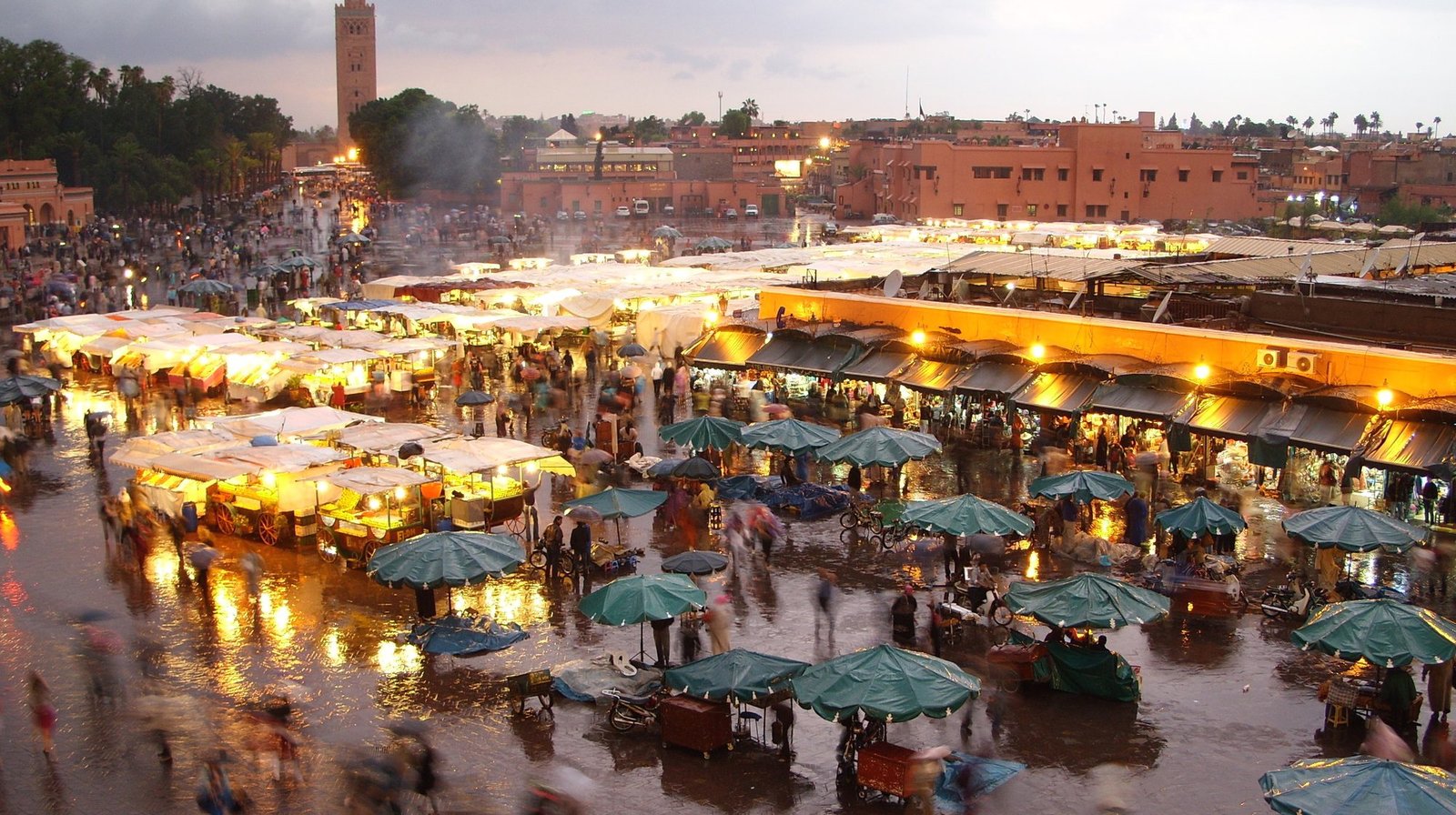
It arrives all at once
Marrakech does not drizzle. The rain here comes as one heavy hour, sometimes two, often in the afternoon, and stops as abruptly as it started. A whole winter’s worth turns up in a handful of those afternoons, somewhere between late October and March.
Nobody can give you the dates in advance. What people here can tell you is that the city changes shape for about four hours and then goes back to being itself. Rain in Marrakech is almost never a lost day — it is a lost afternoon, and only if you had booked the wrong one.
The medina does not drain
The lanes were not built with drainage and most still have none. Water runs to the lowest point in the derb and sits there, sometimes for hours after the sky has cleared, carrying the ochre dust that coats everything here. It stains, and it is slippery in a specific way: fine clay over old cement.
The first consequence is footwear. Every polished surface in the city — riad courtyards, museum thresholds, a shop’s tiled floor — turns dangerous the moment wet feet arrive on it, and babouches have smooth leather soles with no grip at all. People who live here change into trainers when it starts.
The second is that the motorbikes do not stop. A scooter comes through a standing puddle in a lane a metre and a half wide at the speed it came through it dry, and you are the thing that stops the water. Walk on the inside.
The souks carry on. The main arteries are roofed with slats or corrugated sheet, so shopping is one of the few plans that survives intact — except that the slats drip in neat parallel lines and you spend the afternoon in a slow slalom.
What shuts
Every rooftop shuts — bars, restaurants, the terrace you were going to have breakfast on. Some places move you to an indoor room, some simply cancel. If a rooftop dinner matters in the wet months, ask when you book whether there is a covered room.
Jemaa el-Fna empties. The food stalls are assembled from scratch every evening on metal frames, and if it is raining at the hour they would go up, most do not. The musicians and storytellers go home; the orange juice carts stay, because they have a roof. The square is the first thing to empty and the last to fill back in, so a wet evening is not the one to build around it.
The gardens stay open and are close to empty, which is as near as you will get to having the famous ones to yourself.
Petits taxis vanish too. They are hard to find in ordinary traffic and close to impossible in rain, and the meter conversation does not happen: in a downpour everything is negotiated, and the number goes up. If you have a driver for your stay, tell them the night before and agree where they will wait.
Your riad has a hole in the roof, by design
A riad is built around a courtyard open to the sky. That is not a flaw, it is the whole architecture: rain falls into the middle of the house on purpose. The galleries stay dry, the middle does not, and the drain in the centre of the courtyard floor blocks with jasmine and orange leaves — which is why you will sometimes see a member of staff lifting the grate with a spoon mid-downpour.
The real issue is not water, it is cold. A riad is a thick-walled building designed to shed heat for eight months of the year, and it does that job in January too: after a wet day the walls hold the chill and the courtyard pulls cold air through the house.
So ask about heating specifically, and do not accept “air conditioning” as the answer — a split unit set to heat does very little in a high room with a door open onto a courtyard. A real fireplace, proper heaters and enough blankets do. Ask about hot water too: some houses run on a single boiler, and a full house after a cold wet day finds the limit of it by the third shower.
Out of town, the problem is the last kilometre
A lot of villas — in the Palmeraie, along the Ourika road, on the Amizmiz side — sit at the end of a piste, an unsurfaced track between the tarmac and the gate. Dry, it is dust and nobody thinks about it. Wet, it is clay, and a low saloon with four adults and their luggage will not get up it. Ask how the final approach is surfaced before you book. What you want to avoid is finding out at eleven at night with the bags in the boot.
The pool in those months is decoration unless it is heated, and if it is, ask how much notice the house needs — bringing one up from cold is measured in days, not hours.
The flood comes down on a sunny day
This is the part worth the whole article.
The valleys south of the city — the Ourika above all — are funnels. The water that arrives in them fell somewhere in the High Atlas, possibly an hour earlier, possibly where you cannot see it from where you stand. A hot, bright, cloudless afternoon at the bottom of the valley is not evidence that it has not rained at the top.
So if there has been rain in the mountains in the previous day or two, or thunderheads are sitting on the ridge, do not take one of the tables set out in the riverbed and do not leave a car on the gravel. The cafés with their feet in the water are the reason people go, and they are also exactly in the path. People who live in the valley read that sky better than any forecast and will move you up the bank when they think it is coming. If someone tells you to move, move the first time. Nobody argues about it here.
The morning after is the best day of the year
Rain knocks the dust out of the air, and the dust is what stands between you and the mountains for most of the year. The morning after a storm the Atlas is white and close from almost any rooftop, in a way it simply is not in April or September. The light is hard and clean and the palm groves go green for a fortnight. Photographers who work here plan around it. If you get a wet afternoon, move the terrace breakfast or the drive out to the next morning and you have had the better end of the deal.
What to do with the wet hours
- A hammam. The correct weather for it, and the one plan that improves in rain. Book ahead.
- The museums, which are modest in scale — photography, costume and craft, the Yves Saint Laurent museum by the Majorelle garden — so two or three fill an afternoon.
- A cooking class: indoors, several hours, and it ends in lunch.
- Sidi Ghanem, the design district in the industrial zone. Needs a car, entirely under a roof.
- A long lunch somewhere with a fire in it. Nobody puts this on an itinerary and it is often the best afternoon of the trip.
If you are coming between November and March
- Shoes with grip. Not suede, not new, and not the babouches you are about to buy.
- A light waterproof rather than an umbrella: the lanes are too narrow, and sellers appear with umbrellas within minutes of the first drop anyway.
- One warm layer for indoors, which is where you will feel the cold.
- Light trousers will get ochre up the back. It washes out.
The mistake is not coming in the wet months — winter here has the best light of the year and most of its days are bright. The mistake is an itinerary with no indoor version of itself: rooftop dinner, a day in the valley and an afternoon by the pool all stacked on one day. Keep a fallback and rain costs you nothing but a change of order.
Planning a stay in Marrakech?
We are a concierge team based here. Tell us your dates and what matters to you, and we come back with what fits.