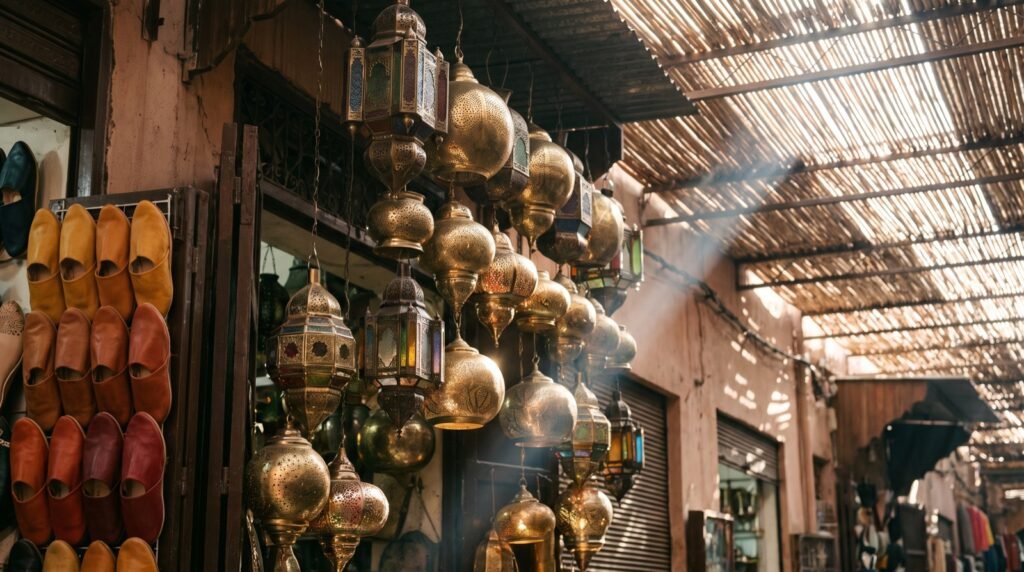
How are the souks organised?
By trade. The market quarters north of Jemaa el-Fna grew out of craft guilds, and the layout still follows them. Souk Semmarine is the wide main artery. Behind it, Rahba Kedima holds the spice and apothecary stalls, the carpet lanes open off its far corner, Souk Cherratine is leather, and Souk Haddadine is where the metalworkers hammer. The useful consequence: find one lantern workshop and you have found thirty. Compare three or four stalls in the same lane before you commit to anything.
What is genuinely made here?
Leather, metalwork and babouches are worked in the medina itself; rugs, argan, spices and most ceramics come from elsewhere in Morocco — plates and tagines from Safi and Fez, green glazed ware from Tamegroute. Hides are tanned at the pits by Bab Debbagh on the eastern wall, a fifteen-minute walk from the Souk Cherratine workshops that stitch them into bags and poufs. Lanterns are cut and soldered in Souk Haddadine and, in greater numbers, at the tinsmiths’ on Place des Ferblantiers. Rugs are woven in Atlas and desert villages — Beni Ourain in thick undyed wool, flatwoven kilims, boucherouite made from cut-up clothing. Argan oil is pressed in the southwest. None of that makes them less real. It does mean nobody in the souk wove your rug.
How do you tell handmade from machine-made?
Turn the thing over. A hand-knotted rug shows individual knots across the back and small irregularities in the pattern, and its fringe is the warp itself rather than a strip sewn on. Machine-made backs look printed and perfectly even. On lanterns, look inside: hand-punched holes vary slightly and leave burrs, while stamped panels are identical. Hand-painted ceramics show brush pressure and a wobble in the line; transfers do not. Babouches should smell of leather and be lined with it, not with fabric or plastic. Real saffron threads have trumpet-shaped ends and release a golden-yellow colour slowly in warm water while staying red themselves; anything that bleeds red at once has been dyed.
Why is the first price not an insult?
Because it is an opening position, and everyone in the transaction knows it. Naming a high number is how the conversation starts, not an attempt to cheat you. Counter at about a third of the opening figure, stay friendly, and move in decreasing steps; most goods settle near half the first number. Say a figure only if you would actually pay it — agreeing and then backing out is the one thing that genuinely offends. Tea is hospitality and obliges you to nothing. Take your time. Rushing is what costs you.
When should you walk away?
When the gap will not close, when you are being physically steered, or when you have simply stopped enjoying it. Walking away is a normal move, not a trick. Sometimes you are called back, often you are not, and either outcome is fine. If a seller follows you down the lane, keep going. Never let anything be wrapped before the price is agreed out loud. If you feel cornered in a back room, leave. There is no obligation.
How do you get bulky purchases home?
Rugs travel better than people expect. A wool rug rolls tight, gets sewn into cloth and goes as checked luggage — check your airline’s hold allowance first. Ceramics need proper packing, so buy fewer and better pieces. Argan oil over 100 ml goes in the hold; smaller bottles can fly in the cabin, but check the current limits. For furniture, large mirrors or several rugs, many sellers can arrange shipping: get the agreement in writing with dimensions, and assume customs and any duty at your end are yours to settle. Some countries restrict food and plant material, so check before you fill a bag with spices.
What actually goes wrong in the souks?
Pressure and navigation. The lanes are a real maze and phone maps struggle under the covered sections, so navigate to the nearest gate or square rather than to a shop. People will offer to guide you, tell you a route is closed, and steer you to a workshop that pays them — the tannery detour is a common version. A polite, firm no is enough. Carry dirhams in 20s, 50s and 100s. Many stalls take nothing else, and nobody will break a 200 for you. Mid-morning, before the tour groups, is the quiet window: at dawn the shutters are still down, and the medina slows around Friday midday prayer. The covered lanes are shaded; the open squares punish you, and winter mornings are cold.
Common questions
Do I actually have to haggle in the Marrakech souks?
In the open souks, yes u2014 goods are rarely labelled and the opening figure is understood by both sides to be a starting point. In fixed-price shops, museum boutiques and craft cooperatives the marked figure is the figure, and pushing against it is out of place. If you are unsure which kind of place you are in, look for labels: no label means bargaining is expected.
Is it rude to walk away without buying anything?
No. Browsing and leaving is a normal part of how the souks work, and sellers deal with it all day. The only genuine breach of etiquette is agreeing a figure out loud and then changing your mind, so only commit to a number you would honestly pay.
How can I tell if a Moroccan rug is really handmade?
Turn it over and look at the back. A hand-knotted rug shows thousands of individual knots, slight unevenness in the pattern, and a fringe that is the warp threads themselves continuing off the end. A machine-made rug has a flat, printed-looking reverse, perfectly repeating motifs, and a fringe stitched on as a separate strip.
Can I take a rug home on the plane?
Usually yes. A wool rug rolls very tight and can be sewn into a cloth cover to go into checked baggage, so check your airline's hold weight and size allowance before you buy. For several rugs, heavy furniture or large mirrors, sea or air freight arranged by the seller is more sensible u2014 get the terms in writing and expect to handle customs and any duty at your end.
How do I know the argan oil is real?
Culinary argan oil is pressed from roasted kernels, so it is deeper in colour and smells clearly nutty; cosmetic oil is pale and almost odourless. Pure oil sinks into skin without leaving a greasy film, and heavy perfume in the bottle usually means it has been blended with something cheaper. Buy it in glass rather than plastic, and remember that liquid limits mean anything over 100 ml will usually have to travel in your hold luggage, while a smaller bottle can go in the cabin.
Planning a stay in Marrakech?
Tell us your dates and what matters to you, and we come back with what fits.