Is Marrakech a good place to take children?
Yes, with adjustments. It is not a city you walk around all day with a toddler. The families who enjoy it treat the trip as a pool holiday with excursions attached, rather than a cultural tour with children in tow. Older children — roughly seven and up — get far more out of the Medina than under-fives, who mostly find it loud.
How do you handle the heat with children in Marrakech?
Split the day and accept that the middle of it is written off. In July and August average highs sit in the mid to high thirties and heatwave days push past 40°C; May and September are hot by northern European standards but usually stay below the mid thirties. Whatever the peak, the stone and tarmac hold that heat well into the evening. Go out early, come back by late morning, and go out again in the last hours of daylight. Hats, sun cream and a water bottle for each child, every time you leave. Shade in the Medina is patchy: the lanes are narrow but the squares are fully exposed. Winter days are genuinely comfortable and the nights are cold — many older buildings are hard to heat, so ask whether your room has heating rather than assuming it. Check the Ramadan dates before booking a late-winter trip: Ramadan moves about eleven days earlier each year and falls in February in 2027. Riads and tourist restaurants keep working, but local places close in daylight, the traffic seizes up in the twenty minutes before sunset, and Jemaa el-Fna is dead all afternoon and then fills at once after iftar. It is workable with children — plan meals around it, and do not eat or drink in the street during the day.
Are the souks too much for small children?
Often, yes. They are crowded, dark in places, and motorbikes pass close in lanes with no pavement. A small child at hip height gets jostled and sees nothing but legs. Traders will engage you directly, and refusing repeatedly is tiring when you are also holding a hand. Go once, go early, keep it short, and agree what happens if anyone gets separated. On Jemaa el-Fna, be ready for the chained Barbary macaques and the snake handlers, and know how it works: nobody asks first. A handler drapes a snake over a child’s shoulders or puts a monkey on their arm as you pass, then negotiates the money while your child is holding the animal. The macaques bite and scratch, so with children it is a rabies question as well as an upsetting one. If you do not want it, keep small children on the inside and keep walking — a firm la, shukran without stopping is enough. If you do, settle the payment before anyone touches your child. Both trades are the target of ongoing animal-welfare campaigns.
Why the pool matters more than the sights
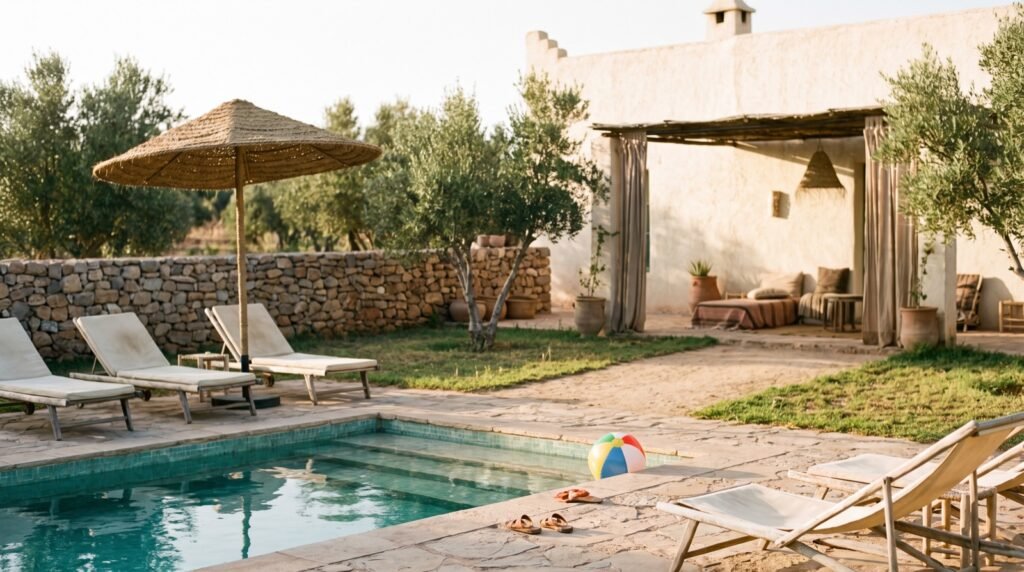
For most families the pool is the holiday, so where you stay matters more than your itinerary. Children will happily spend most of a day in the water, and for many families that is the part of the trip they remember. Check two things before booking: whether the pool is heated, and how much sun it gets. Many courtyard pools inside the Medina are small and shaded by high walls. In spring or autumn, an unheated plunge pool is decoration, not a pool. The water parks out on the edge of the city, about twenty minutes’ drive, buy you a whole day: shaded lawns, a wave pool and slides sized for small children. They are summer operations, so check one is running before you plan a day around it.
Gardens, calèches and space to run
Gardens and a calèche ride are the easiest wins with young children, because both offer space and a seat. The Menara is the dependable garden: olive groves with real shade and room to move that the Medina does not have. Its basin is deep and unfenced right to the edge, so one adult watches it the whole time rather than letting children loose. Parc Lalla Hasna, below the Koutoubia, is small, properly shaded and five minutes from the square, which makes it the easy one for breaking up a morning. Leave the Agdal out: royal property, unpredictable opening, shut for long stretches, and bare orchard with no shade, no water and no toilets. Calèches wait at the rank on Place de Foucauld beside Jemaa el-Fna and at Place de la Liberté in Guéliz, and the standard circuit loops the ramparts in about an hour. Read the official tariff board at the rank before you get in, then agree the route and the number of hours, because the first price quoted to a family with children rarely matches the board. The Jardin Majorelle is the garden everyone means in Guéliz: pretty, tiny and single-file. Entry is by timed slot booked online, and in spring the slots go several days ahead. With a pushchair you spend the visit waiting for gaps in the path, so carry small children instead. The museum next door is a separate ticket and holds a five-year-old for about ten minutes.
Ourika valley or Agafay: which day trip works with children?
Ourika suits younger children, Agafay suits older ones. The bottom of the Ourika valley is about an hour south and several degrees cooler, with a river and riverside cafés whose tables stand in the shallows — you are expected to order if you use them. Setti Fatma, where the waterfall walk starts, is further up, nearer an hour and a half each way. Go on a weekday: at weekends and on public holidays the valley is where Marrakech goes on its day off, and the road can take twice as long in each direction. The walk to the waterfalls is a rocky scramble with unprotected drops and stepping-stone river crossings. The first fall is about 45 minutes each way and is hard work with under-sevens — carrying age, not walking age. The rest are out of the question with young children. Grippy closed shoes matter, the rock stays slippery for days after rain, and the river can rise fast after rain higher up the valley. Agafay, about forty minutes out, is stony desert, not sand dunes; people who arrive expecting the Sahara are disappointed. Camel rides there are short and slow, which suits small children well. Quad bikes and buggies are noisy and dusty, and young children usually ride as passengers with an adult — check the age rules before you book. Go at the end of the day.
What children eat, and getting around with a pushchair
Plain food is easy to find; pushchairs are not. The exception is Ramadan, when most Medina cafés, stalls and juice carts close during daylight and only hotels, riads and tourist restaurants serve lunch. Chicken, brochettes, bread, chips, plain couscous and fresh orange juice cover most children, and tagines are mild rather than spicy — though the sweet ones with prunes divide opinion sharply. Pancakes and pastries handle breakfast for fussy eaters. Give children bottled water. On the ground: Medina lanes are uneven, stepped in places and often too narrow to push a pushchair through a crowd, so bring a carrier for anyone light enough. In the newer districts the pavements are wide and a pushchair is fine. Taxis do not normally carry child seats, and petits taxis are small and take only a few passengers, so a family of four usually needs two of them or a booked car — ask about seats and capacity when you book. Petits taxis are also city-only and cannot reach Ourika or Agafay: for those, take a grand taxi from the rank at Bab er Robb, which seats six and has no seatbelts worth the name, or book a car and driver for the day. With young children the driver is the version worth paying for, because the car waits for you.
Common questions
Is Marrakech too hot for a holiday with young children?
In high summer the middle of the day is too hot for small children in Marrakech: July and August average highs sit in the mid to high thirties, heatwave days push past 40u00b0C, and the city holds that heat into the evening. Families cope by going out early, returning to the pool from late morning until late afternoon, then going out again. Spring, autumn and winter days are far easier with children.
Should I take a pushchair to Marrakech?
A carrier works better than a pushchair in the Marrakech Medina, where the lanes are narrow, uneven, stepped in places and shared with motorbikes. A pushchair is fine in the newer districts, where the pavements are wide. If you only bring one thing, bring the carrier.
Can I take a toddler into the souks?
You can, but keep it short and go early in the day. The souks are crowded and dark in places, motorbikes pass close in lanes with no pavement, and a toddler at hip height sees only legs. Most families find one brief visit is enough with under-fives. On Jemaa el-Fna, keep small children on the inside and keep walking past the macaque and snake handlers, who put an animal on a child first and negotiate the money afterwards.
What is there for kids to do in Marrakech apart from sightseeing?
Swimming, gardens and short excursions are what actually work with children in Marrakech. The pool takes up most of a family's day and the water parks on the edge of the city buy a whole one, the Menara's olive groves give children space to run that the Medina does not, and a horse-drawn calu00e8che ride around the ramparts gives everyone a seat and some shade. Out of town, the Ourika valley has a river to paddle in and the Agafay desert has camels and buggies.
Will my children eat the food in Morocco?
Most children eat well in Morocco. Chicken, brochettes, bread, chips, plain couscous and fresh orange juice are widely available, and tagines are mild rather than spicy u2014 although the sweet versions with prunes divide children sharply. The exception is Ramadan, when local cafu00e9s and stalls close during daylight and only hotels, riads and tourist restaurants serve lunch. Give children bottled water rather than tap water.
Planning a stay in Marrakech?
Tell us your dates and what matters to you, and we come back with what fits.