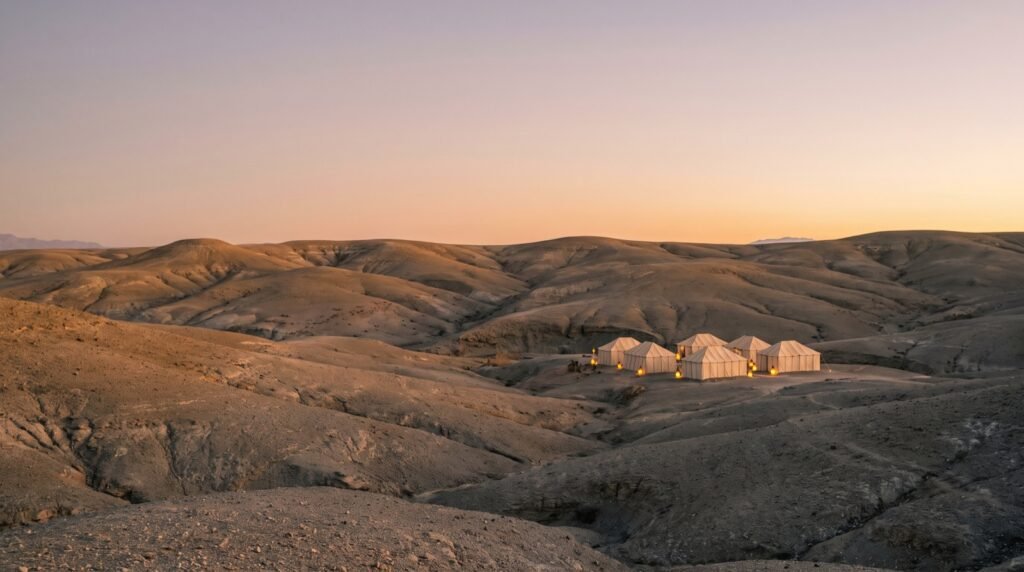
Is Agafay actually a desert?
Yes, but it is a stone desert, not a sand one. Agafay is pale chalky hills, dry riverbeds and gravel, with scrub, thorny sedra bushes and the odd olive tree. There are no dunes. Photographs showing golden sand were either taken elsewhere or show sand brought into a camp. What Agafay has is space, silence and, on a clear day, the High Atlas on the horizon, with snow on the ridge from about December through to April.
How far is Agafay from Marrakech?
About 35 to 40 minutes south-west on the Amizmiz road from Hivernage or the Agdal, nearer an hour from the Medina in traffic. It is tarmac most of the way, then a piste – a graded dirt track – for the last stretch to most camps. A normal car manages that slowly in dry weather. After heavy rain the tracks turn to mud and the dry riverbeds run, which is when transfers get cancelled. Mobile signal is good in places and absent in others, so fix your pick-up point and time before you leave.
What is there to do in Agafay?
Camps, meals and riding. Most visits are built around a camp: lunch or dinner, a pool in the warm months, cushions, music, a fire when it is cold. Camps sell fixed packages; pool use is often a separate day pass with a minimum spend, so ask what is included. Beyond that:
- Camel riding, usually a short loop rather than a trek
- Quad bikes and buggies, which are noisy and dusty and exactly as fun as that sounds
- Horse riding
- Overnight stays in tents, from very simple to properly comfortable
- Walking, which is easy to overlook and rewards the effort
There is no souk, no monument, no row of cafés. The douars on the plateau – Agafay is a farming commune – are homes and fields, not sights. It is not somewhere you explore. It is somewhere you sit. Plan for that, or combine it with the reservoir at Lalla Takerkoust nearby.
When is the best time to visit Agafay?
Late afternoon into the evening, almost always. There is no shade out there and no relief from the sun. In high summer the middle of the day is punishing, and a midday visit means sitting under canvas waiting for the heat to break. Go out mid to late afternoon, take the sunset, eat, then drive back or stay. Check the sunset time before booking: it shifts a couple of hours across the year, so winter means a mid-afternoon pick-up, summer an early-evening one. In Ramadan the clocks go back an hour and dinner comes after sunset.
Winter days are mild, clear and excellent for walking. Winter nights are genuinely cold, colder than people expect of a desert. After spring rain the hills turn green, briefly.
Can you see the stars in Agafay?
Yes, far better than from the city, though this is not true wilderness sky. Marrakech throws a glow across the horizon and camps light themselves. The bigger factor is the moon: a full moon washes everything out, a new moon gives you the Milky Way. Check the moon phase before booking an overnight if stars are the reason you are going, and walk a little away from the camp lights once you are there.
What should you bring to Agafay?
Layers, closed shoes and more water than you think.
- A jacket or jumper from autumn through spring – winter nights get close to freezing; in high summer a light layer is plenty
- Trainers or boots, because the ground is loose gravel and shale and sandals fill with grit
- Sun hat, sunglasses, high-factor sun cream
- Water for the drive, even if the camp provides it
- A torch, or your phone light, for walking between tents
- Some cash, in case card payment fails out there
Leave the white linen at the riad. Everything gets dusty.
Is Agafay a substitute for the Sahara?
No. The dunes people picture are at Merzouga or Erg Chigaga, nine to ten hours’ drive each way, over the Atlas. Agafay is a stone plateau 40 minutes from your hotel. It gives you a night under the stars and dinner with a view; it does not give you an ocean of sand. If you have three or four days and you want the dunes, do the real trip. If you have one free evening, Agafay earns it – provided you go knowing what it is.
Common questions
Are there sand dunes in Agafay?
No. Agafay is a stone desert of pale rocky hills, gravel and dry riverbeds, about 40 minutes from Marrakech. Any sand you see at a camp there has been brought in.
How long do you need in Agafay?
Half a day is enough for most people. A typical Agafay trip leaves Marrakech in the mid to late afternoon, takes in the sunset and dinner at a camp, and returns to the city the same night. Staying overnight mainly adds a darker sky and the sunrise.
Is Agafay too hot in summer?
At midday in summer, yes. Agafay is an open stone plateau with no shade, so a midday visit means sitting under canvas waiting for the heat to pass. Go in the late afternoon instead, when the temperature starts to drop.
Do you need a 4x4 to get to Agafay?
Usually not. The road from Marrakech to Agafay is tarmac most of the way, with a dirt track for the last stretch that an ordinary car can manage slowly in dry weather. After heavy rain those tracks turn to mud, and that is when trips get cancelled.
Can you do Agafay and the Sahara on the same trip?
Only if you have several days. Agafay is a stone desert about 40 minutes from Marrakech and works as an evening out, while the Sahara dunes at Merzouga or Erg Chigaga are nine to ten hours' drive each way over the Atlas mountains. They are two separate trips, not alternatives to each other.
Planning a stay in Marrakech?
Tell us your dates and what matters to you, and we come back with what fits.