How far are the Atlas Mountains from Marrakech?
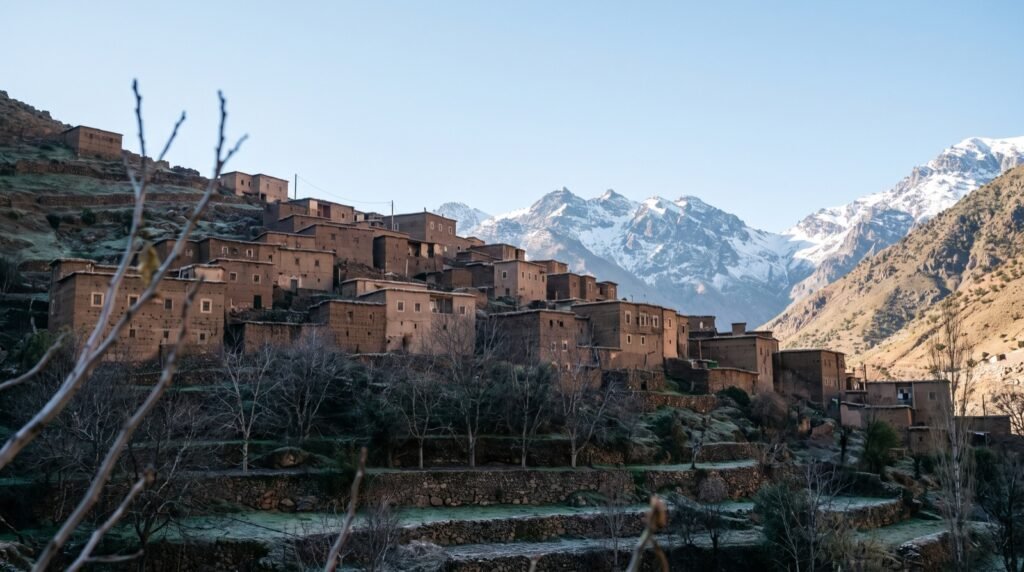
The first mountain villages are about an hour from the city, and the main trailheads about ninety minutes. On a clear day you can see the range from rooftops in town. The road climbs fast: the plain ends, the ground tilts, and you are into walnut terraces before you have finished your coffee. Three destinations take most visitors. Ourika is the closest valley, Imlil the deepest road-served one, Oukaimeden the high plateau between them. The Tizi n Tichka is not a valley at all but the pass that carries the road over the range towards the south.
One thing to know before you go: the earthquake of 8 September 2023 was centred in these mountains, in Al Haouz province south-west of Imlil. The roads and the trekking reopened long ago, but you will drive past rebuilt houses, half-finished walls and prefab shelters. The guides and muleteers you hire lost family and homes here; a day in the valleys is money that stays in them.
Imlil is the base for Toubkal, about ninety minutes out
Imlil is where the tarmac stops and mules take over. It sits at roughly 1,700 metres in a bowl of terraced fields. From the village you can walk the flat hour to Aroumd, the big terraced village at the head of the valley, and come back down the far side of the riverbed; climb an hour to the Tizi n’Tamatert or the Tizi n’Mzik for the view back over the terraces; take a full day up the Toubkal path to the shrine at Sidi Chamharouch, about three hours each way, where the white-painted rock and the shrine are closed to non-Muslims, though the walk is not; or start for Toubkal itself.
Jbel Toubkal is 4,167 metres, the highest peak in North Africa. In summer it needs no technical skill, but it is long, steep and thin-aired, and is normally done over two days with a night at the huts below the summit, at around 3,200 metres. There are two, side by side, and both fill in spring and at the end of summer, so have your guide book the bed when you book him, and budget for his day rate, half board at the hut and a mule if you would rather not carry your own bag. In winter it needs crampons, an ice axe and the experience to use them. A licensed mountain guide is required for Toubkal and the rule has been enforced at the park entry in recent years, so confirm the current requirement when you book. Arrange it before you drive up, not on arrival.
Is the Ourika valley worth a day?
Yes, if you want mountains without commitment. The lower valley is about an hour out and the easiest of the valleys to reach; Setti Fatma at the head of it is nearer ninety minutes. Go on a weekday if you can: on Sundays and right through the summer this is where Marrakech goes to picnic, and the road up runs nose to tail. Monday is the souk at Tnine Ourika, the name being the day, as Saturday is at Asni on the Imlil road. Both are working markets rather than a display, and both clog the road in the middle of the day.
The road follows the river, narrowing as it climbs, with cafes built on stilts over the water. At the head of the valley, at Setti Fatma, a chain of waterfalls runs up a rocky gorge. The first fall is maybe half an hour of scrambling over wet boulders. The higher ones are harder than they look. Wear shoes with grip; sandals are how people get hurt here.
Expect to be met in the car park by someone offering to take you up. They are not official and the path is obvious; the argument comes at the end, over what you owe. If you want one, agree what you are paying and how many falls before you start walking. If you do not, say so once, clearly, and keep going.
One real warning: the river can rise very fast after a storm higher up the valley, even when it is dry where you are standing. If the water is loud and running brown, stay off the riverbed.
Can you see snow near Marrakech?
Usually, yes. Oukaimeden, around ninety minutes up, sits at roughly 2,600 metres, with the slopes above it reaching about 3,270 metres, and catches snow most winters. There is a small ski station, but its ageing lifts have been out of action for several seasons and a long-promised rebuild has yet to deliver, so check before you count on one running. Skis, boards and sledges are still hired out at the roadside, and in practice people walk up and ski down. Cover is unreliable and varies enormously year to year, so treat skiing as a bet rather than a plan. Out of season it is a wide, bare plateau, good for walking, with prehistoric rock carvings on the slabs near the village.
What is the Tizi n Tichka pass like to drive?
It is the road over the High Atlas towards Ouarzazate, topping out above 2,200 metres. Roughly two hours to the pass from Marrakech, about double that to Ouarzazate. It is a well-used main road and largely in decent condition, though roadworks and weather damage change what you meet from one season to the next. Either way it is one continuous sequence of bends, often behind a lorry. If anyone in the car gets travel sick, this is where it happens: sit in front, take something before you leave. Snow closes the pass occasionally in winter. The kasbah at Telouet sits off the old road near the top, and Ait Ben Haddou is on the far side.
How much colder is it than the city?
Much colder, in every season. Reckon on six or seven degrees below Marrakech at Imlil, January highs of about 12C against the city’s 19C and July highs of about 30C against 36C, appreciably more at Oukaimeden, and more again once the sun drops behind a ridge. A pleasant spring afternoon in the city can be genuinely cold in a shaded valley. Bring a fleece and a windproof layer in summer, a proper coat, hat and gloves in winter, and closed shoes whatever the season. Nights are cold year-round.
What is a Berber village visit actually like?
You will be offered mint tea, poured from a height, and it will be sweet. Take it. Refusing reads as brusque, and the tea is how a conversation starts rather than a transaction. That is true in a house you have actually been invited into. It is not what happens on a cheap day tour, where the Berber house and the argan cooperative are sales stops with tea attached. There is no obligation to buy at either; thank them for the tea and walk on.
Most High Atlas households are Amazigh, with Tashelhit as the first language and Moroccan Arabic the usual second. French turns up mainly with younger men who work in tourism, and many older people and women speak Tashelhit only. A few words of Tashelhit go further than either: azul for hello, tanmirt for thank you, and la bas, the all-purpose how-are-you that everyone answers with la bas.
Dress modestly, ask before photographing anyone, and expect children to be curious. Do not hand out sweets, pens or coins; it is exactly why children in the more visited valleys now stop cars asking for them. If you want to give something, give it to the school, or spend the money in the house you are sitting in. Hospitality here is real and unhurried, which means a village stop takes longer than you planned. Let it. Rebuilding after the earthquake is still under way in these villages: you will see it from the road, and it is not a photo subject.
Common questions
How long does it take to get to the Atlas Mountains from Marrakech?
The lower Ourika valley is about 45 minutes to an hour from Marrakech, but Setti Fatma at its head is nearer ninety minutes. Imlil is about ninety minutes and Oukaimeden roughly the same. Mountain roads are winding, so allow more time than the distance suggests and expect to sit behind lorries. Without a car, shared grand taxis for the Ourika and for Asni, where you change for Imlil, leave from Bab er Robb and go when the sixth passenger turns up rather than on a timetable. A car and driver for the day is the usual alternative, with what you are paying agreed before you set off rather than at the end. The cheapest seat-in-a-minibus tours are the ones that build in an argan cooperative and a camel field on the way out of town.
Do I need a guide to climb Toubkal?
Yes. A licensed mountain guide is required to trek Jbel Toubkal, and this is checked in the Toubkal national park. Arrange the guide in advance rather than turning up at Imlil and looking for one on the day.
Is there really snow near Marrakech in winter?
Yes, usually. Oukaimeden sits at around 2,600 metres in the High Atlas, about ninety minutes from Marrakech, and catches snow most winters, typically between January and mid-March. There is no snowmaking, cover varies enormously year to year, and several recent seasons have been thin and short with the resort's lifts sitting idle through them. Treat a ski day as a bet rather than a fixed plan, and check both what is actually lying and whether anything is running before you commit a day to it.
What should I wear for a day trip into the mountains?
Dress considerably warmer than you would in Marrakech. The High Atlas valleys run about six or seven degrees colder than the city, more at altitudes like Oukaimeden, and colder again in shade or after sunset. Closed shoes with grip matter more than anything else, especially near waterfalls or on wet rock.
Can you walk in the Atlas if you are not especially fit?
Yes. There are gentle valley walks of an hour or two between villages and along irrigation channels that need no particular fitness, only decent shoes. Summit routes such as Jbel Toubkal are a different matter entirely: long, steep, high-altitude days that require preparation and a licensed guide.
Planning a stay in Marrakech?
Tell us your dates and what matters to you, and we come back with what fits.