Highlights
- Five en-suite bedrooms, two floors
- Four orange trees in the courtyard
- Plunge pool, roughly four by two metres
- Hand-cut zellige, carved cedar doors
- Reed-shaded breakfast corner on the roof
The house
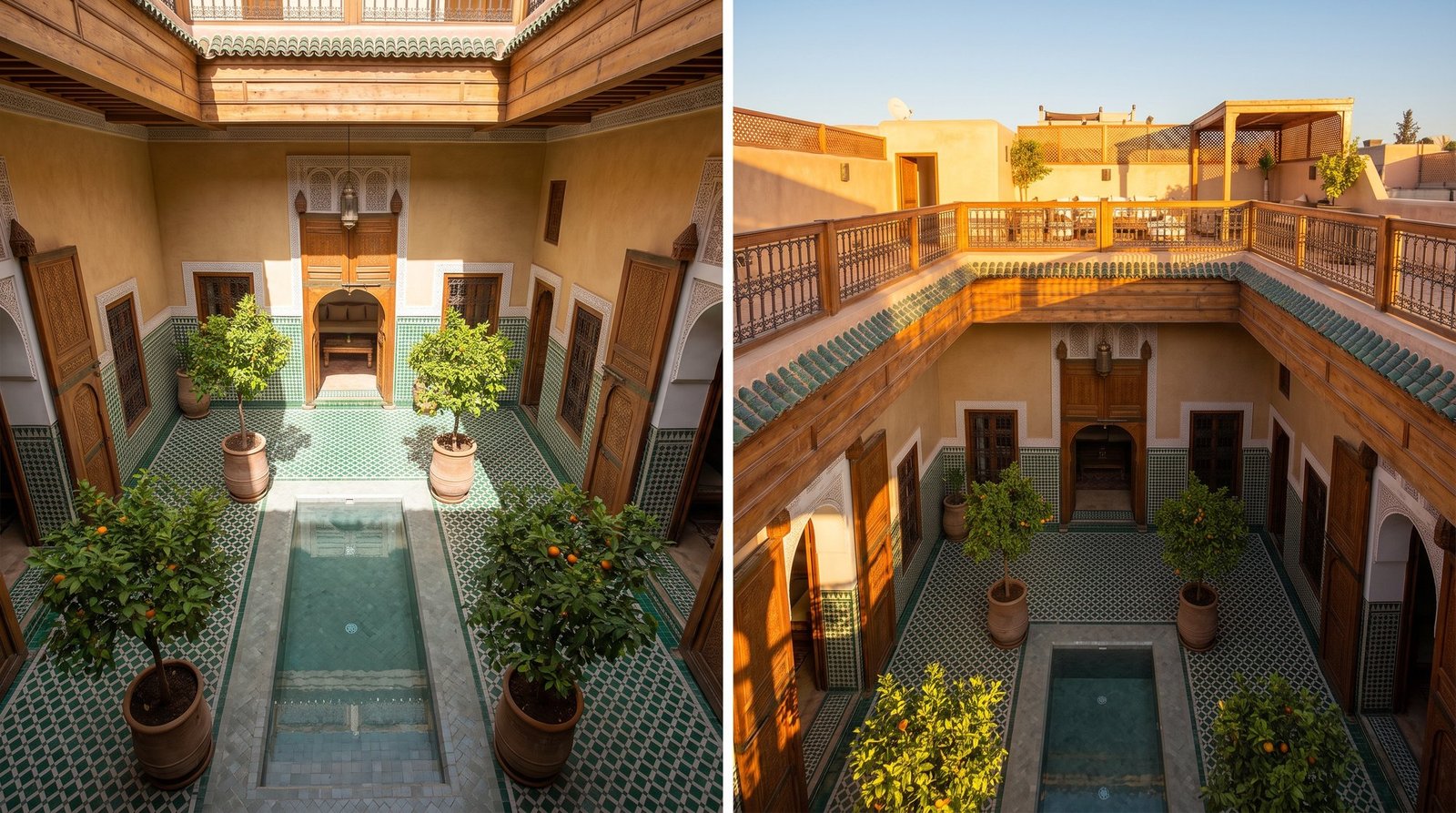
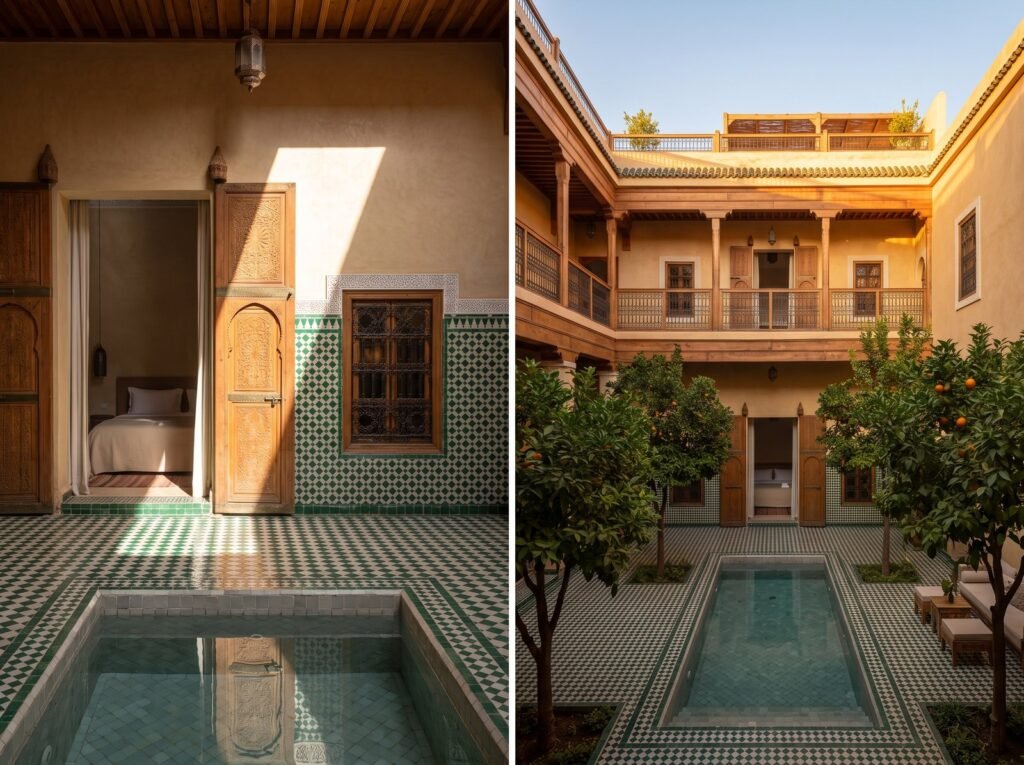
The plan is the standard one and none the worse for it: rooms on all four sides of a square courtyard, two floors, a gallery running round the upper one. Four orange trees grow in the courtyard and a plunge pool of roughly four metres by two runs along one side, which is enough to sit in and cool down rather than swim lengths. The zellige on the lower walls and the cedar of the doors and rail were cut by hand. Three of the five bedrooms are on the ground floor and two open onto the gallery; all five have their own bathrooms.
How the days go
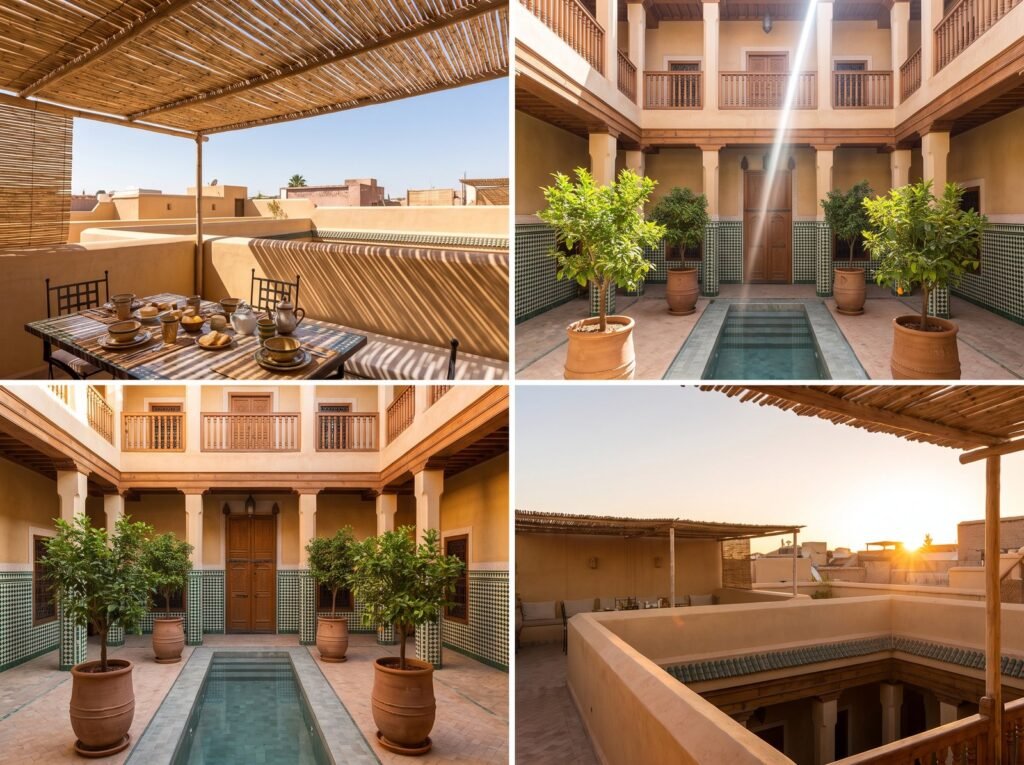
The courtyard does most of the work. It holds shade for much of the day and runs noticeably cooler than the lane outside, which is why groups end up eating there instead of in the dining salon. Breakfast usually happens on the roof, in the corner under the reed canopy, before the sun comes round to it. The two ends of the house are far enough apart that a late night and an early start need not collide, which matters when ten people share a front door. A house of this size normally runs with a housekeeper, and a cook can usually be arranged.
Amenities
- Five en-suite bathrooms
- Plunge pool in the courtyard
- Reed-shaded roof terrace
- Air conditioning, normally in every bedroom
- Kitchen set up for a cook
- Wi-Fi throughout the house
Ideal for
Available on request
- Cook for lunch and dinner
- Airport transfers
- Guided walk through the souks
- Day trip to the Atlas
- Childcare
Charged separately from the stay and confirmed case by case.
Gallery
The area
Inside the walls, the street tells you nothing: a plain door, then a courtyard. From here you walk into the souks rather than drive to them, which is the point of staying in the Medina and also what you give up. Cars cannot reach most doors, luggage comes the last stretch by cart or on foot, and there is no garden and no full-length pool to be had inside the old city.
What the photos won't tell you
Every listing in the world photographs the pool from its best corner, and no photograph answers the questions that decide a stay. So before you commit, we put the following in writing for your dates:
- How far the car gets, and how many metres and steps remain with the luggage.
- Who the neighbours are, and what you will hear at five in the morning.
- Whether the pool is heated, and in which months that decides whether you swim.
- What “staffed” covers — who is there, at what hours, and who cooks.
- Where the wifi actually reaches, not just where the router is.
- Which of the property’s own photographs were taken with a wide-angle lens, and what a room looks like from the doorway.
Common questions
Can we be dropped at the door?
Not usually. The lanes on the approach are too narrow for a car, so vehicles stop at a nearby square and the last few minutes are done on foot, with a cart for the bags. It is worth packing with that in mind.
Is it sensible with small children?
With supervision, yes. The plunge pool is unfenced and the stairs are stone with a low rail, which is normal for a riad of this age. The ground floor works well for a couple with a toddler, since three of the five bedrooms are on it.
Can we eat at the house?
Usually, yes. The kitchen is set up for someone to cook in properly rather than for guests to assemble a salad, and a cook can normally be arranged for breakfast, lunch or dinner. Most groups eat in the courtyard and go out two or three evenings.
How hot does it get inside in summer?
The courtyard sits in shade for most of the day and stays a good deal cooler than the street, and bedrooms in a riad of this standard are normally air-conditioned. July and August afternoons are still for staying in; the house was designed around that rather than against it.
Request this stay
Tell us your dates and how many of you there are. A person reads it and answers.