Highlights
- Six en-suite bedrooms
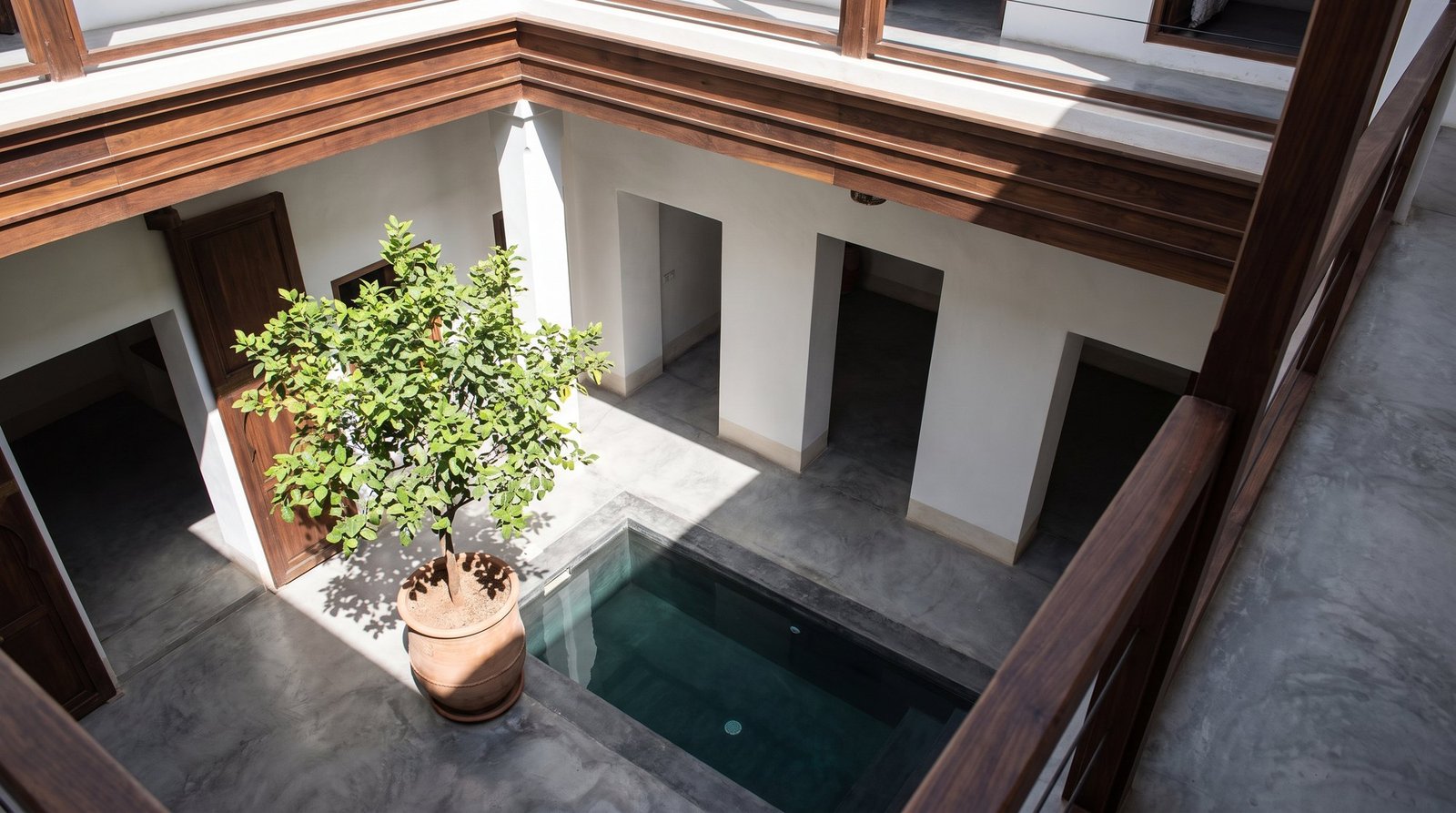
- Plunge pool in the courtyard
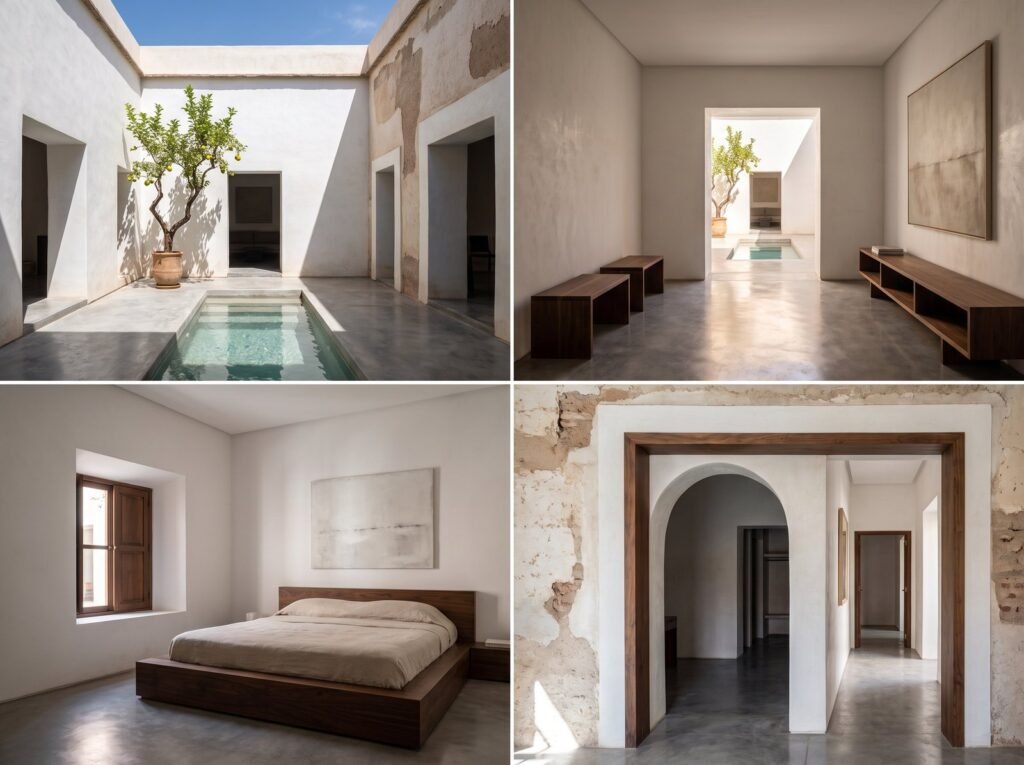
- Flat white gallery walls
- Two ground-floor sitting rooms
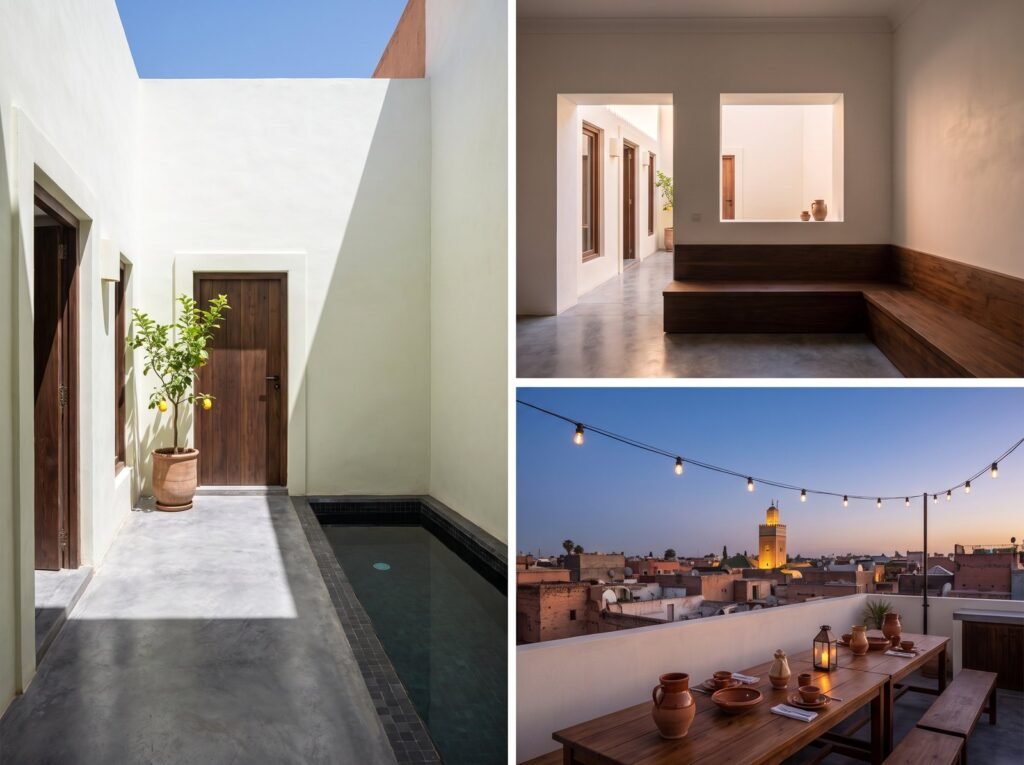
- Roof terrace laid for dinner
The house
The bones are old and were left alone: thick walls, a courtyard open to the sky, rooms that turn their backs on the street. What went in afterwards is modern. Floors are poured and polished, walls are flat white, and the doorways were squared off rather than arched, so the eye runs from one room into the next. Six bedrooms are spread over two floors, each with its own bathroom, and none of them shares a wall with a stairwell. Twelve guests is the number the house is arranged for.
Living in it
Downstairs there are two sitting rooms, which matters in a house this size: one can hold a late conversation while the other empties. In the courtyard, the plunge pool is short — closer to a cold bath than a swim — and it does the job in August. The roof is the evening room. It is laid out for a long table, with shade over part of it and a minaret visible past the neighbouring terraces. Breakfast is usually served wherever you were sitting last, courtyard or roof, and a cook can be arranged for the rest of the day.
Amenities
- Air conditioning in every bedroom
- Courtyard plunge pool
- Roof terrace with shade and a long table
- Two sitting rooms and a small library downstairs
- Wi-Fi throughout the house
- Housekeeping, normally daily
Ideal for
Available on request
- Cook for lunch and dinner
- Airport transfers with porter
- Guided medina walk
- Massage at the riad
- Car and driver for day trips
Charged separately from the stay and confirmed case by case.
Gallery
The area
Mouassine sits in the northern half of the medina, in the part of it where things are still made rather than only sold. Joiners work with the doors open, dyers hang wool on lines strung across the lane, and a few small galleries have taken rooms among them. The noise in the daytime is work noise — a saw, a hammer, a handcart — rather than traffic.
What the photos won't tell you
Every listing in the world photographs the pool from its best corner, and no photograph answers the questions that decide a stay. So before you commit, we put the following in writing for your dates:
- How far the car gets, and how many metres and steps remain with the luggage.
- Who the neighbours are, and what you will hear at five in the morning.
- Whether the pool is heated, and in which months that decides whether you swim.
- What “staffed” covers — who is there, at what hours, and who cooks.
- Where the wifi actually reaches, not just where the router is.
- Which of the property’s own photographs were taken with a wide-angle lens, and what a room looks like from the doorway.
Common questions
How does arrival work if a car cannot reach the door?
A driver normally takes you as far as the vehicles go, a short walk from the riad, and a porter is usually there with a barrow for the luggage. The last stretch is a few minutes on foot through lanes too narrow for a car.
Is the house taken by one group at a time?
Usually, yes. Houses of this size are normally taken whole rather than room by room, so the courtyard, the sitting rooms and the roof stay with one group rather than being shared. Twelve is the sensible number for it.
Is it noisy, being this close to the centre?
Riads face inwards, so street noise mostly stops at the front door. What carries instead is the call to prayer, birds in the courtyard and a workshop starting early somewhere nearby. The two upper-floor bedrooms are the quietest of the six.
Does the modern interior mean the old character has gone?
The structure was not touched: the same thick walls, the same courtyard open to the sky, the same cool that comes with both. What changed is the surfaces and the light. It reads as an old Marrakech house that someone has emptied and rehung, not a new build.
Request this stay
Tell us your dates and how many of you there are. A person reads it and answers.