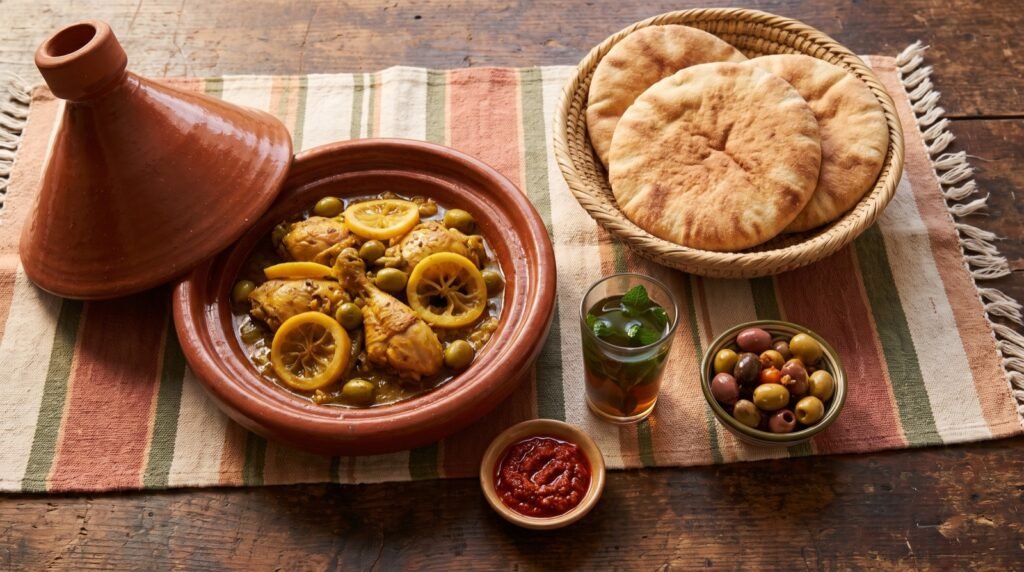
What is a tagine, and which one should you order?
A tagine is a slow-cooked stew named after the conical clay pot it cooks in, not a single recipe. The lid condenses the steam and returns it to the meat, so almost nothing escapes — you start with barely any liquid and the dish cooks in its own juices, which is why you get a few spoonfuls of concentrated sauce rather than a soupy stew. Four versions turn up almost everywhere:
- Chicken with preserved lemon and green olives. A straightforward first order, and the version most kitchens cook most often.
- Lamb or beef with prunes, almonds and cinnamon. Sweet and rich. Share one.
- Kefta: spiced meatballs in tomato sauce, with eggs cracked in at the end.
- Vegetable tagine. Ask whether the broth is meat-based, because it often is.
Eat it with bread, right hand, from the section of the dish in front of you. Said plainly: restaurant menus start to repeat quickly. Restaurant cooking here is narrower than what families cook at home.
Why is couscous eaten on Friday?
Couscous is the Friday meal, eaten at midday after communal prayer. The semolina is steamed several times over a broth of vegetables and meat until it is light rather than sodden. Places aimed at visitors serve it daily, and it is often the weakest thing on the menu — steamed early and held warm. If you want good couscous, ask your riad the day before so someone can cook it properly.
What is tanjia, and why only in Marrakech?
Tanjia is the Marrakech speciality: beef or lamb with preserved lemon, garlic, cumin, saffron and smen, sealed in a tall clay urn and left for hours in the embers of a hammam furnace. The man who keeps the bathhouse fire going — the farnatchi — is the one who cooks it. You leave the sealed urn at his furnace door in the morning with a small fee for a place in the ashes, and collect it in the afternoon. The meat comes out collapsing and deeply perfumed, eaten with bread and nothing else. It is traditionally a workers’ dish, made to order rather than kept ready, so ask a day ahead. It is the dish most closely identified with Marrakech, and far easier to find here than anywhere else in Morocco.
Pastilla, harira and mechoui: what are they?
Pastilla is a sweet-savoury pie, harira is a thick soup, and mechoui is slow-roasted lamb. Pastilla uses paper-thin warqa pastry around shredded pigeon or chicken with almonds and cinnamon, dusted with icing sugar — sweet and savoury at once, which some people love and some cannot get past. Harira is tomato, lentil and chickpea, heavy with coriander, parsley and celery, thickened at the end with tadouira — a flour-and-water slurry stirred in slowly — and sharpened with lemon at the table; it is what Moroccans break the fast with during Ramadan and an everyday evening dish the rest of the year. Mechoui is lamb roasted slowly in a clay pit oven until it pulls apart, sold by weight at the pit ovens in Souk Ablueh, the short alley off Jemaa el-Fna lined with olive stalls that everyone calls Mechoui Alley — go around midday, because they carve until the animal is gone and then close — and eaten with cumin and salt on the side.
What do Moroccans eat for breakfast?
Bread, mostly. Msemen is a square of dough folded and fried until it is flaky, eaten with butter and honey or with amlou, an almond and argan paste. Beghrir is a spongy semolina pancake covered in small holes that soak up melted butter and honey. Alongside them: khobz, olives, olive oil, soft cheese, eggs, coffee or mint tea. It is a sweet, starchy start to the day. Hotel buffets lean on croissants and cereal; the Moroccan breakfast is better, and you usually have to ask for it.
Mint tea, and the orange juice stalls on Jemaa el-Fna
Mint tea is gunpowder green tea, fresh spearmint and a good deal of sugar, poured from height to put a head of foam on the glass. It is offered constantly — on arrival, mid-negotiation, whenever you sit down. Ask for it light on sugar if you want to taste the mint, and say so before it is made, because the sugar goes into the pot. Orange juice is squeezed to order at the stalls on the square. Watch the oranges pressed in front of you, and ask for a disposable cup rather than one of the glasses, which get rinsed in a bucket of standing water between customers. The price is painted on the cart and is the same at every stall, so there is nothing to negotiate — what you watch is your change, which has a habit of arriving slowly or not at all, so hand over small notes.
What should you be careful about?
Stomach trouble here comes more often from how food is handled — raw, washed or reheated items, and anything held lukewarm — than from a tagine cooked to order; untreated water and ice can do it too. Drink bottled or filtered water, skip ice you have not seen made, and be wary of raw salads and anything washed and served cold. Peel your own fruit. Food cooked to order at a busy stall with turnover is safer than a lukewarm buffet. In summer, a heavy tagine at midday will flatten you — eat lightly in the heat and properly after dark.
Common questions
What food is Marrakech actually famous for?
Tanjia: beef or lamb sealed in a tall clay urn with preserved lemon, garlic, cumin, saffron and smen, then cooked for hours in the embers of a hammam furnace. It belongs to Marrakech and is rarely found elsewhere in Morocco. It is cooked from scratch rather than plated to order, so a riad or small kitchen will usually want a day's notice — though many Marrakech restaurants keep it on the daily menu.
Is the fresh orange juice on Jemaa el-Fna safe to drink?
It is generally fine if you watch the oranges pressed in front of you and ask for a disposable cup rather than one of the glasses, which are rinsed in a bucket between customers. The price is posted on the cart and identical across the stalls, so there is nothing to agree — just carry small notes, because change is where these stalls make their money.
What's the difference between a tagine and a tanjia?
A tagine is a stew cooked in a shallow dish under a conical lid, made all over Morocco and eaten every day. A tanjia is chunks of meat — usually beef, sometimes lamb — sealed in a tall clay urn and cooked slowly in the furnace of a hammam, and it is closely associated with Marrakech. Tagine you order off a menu; tanjia you order the day before.
Can vegetarians eat properly in Morocco?
Yes, but you have to be explicit. Vegetable tagine, couscous and soups are frequently built on meat stock, and "no meat" is sometimes understood as "no visible pieces of meat". Ask specifically whether the broth is meat-based, and lean on bread, eggs, olives, lentil and bean dishes, and breakfast items like msemen and beghrir.
Why is Moroccan mint tea so sweet, and can I ask for less sugar?
The sugar is boiled in the pot together with gunpowder green tea and fresh spearmint, so it cannot be adjusted once the tea is poured. Ask for it light on sugar before it is made. Pouring from a height aerates the tea and raises foam in the glass; it is not done for show.
Planning a stay in Marrakech?
Tell us your dates and what matters to you, and we come back with what fits.